
Most adults who experienced childhood trauma don’t start by asking, “Did I experience trauma?” They ask different questions. Like, why do I always assume people are upset with me? Why do I work so hard but never feel like I’m doing enough? Why is it so hard to relax, even when everything in my life is going well? Why do I apologize for everything, or feel guilty for needing help?
Those questions tend to arrive one at a time, and they usually look unrelated. Anxiety. Perfectionism. People pleasing. Relationship trouble that repeats itself with different people in the same shape. It rarely occurs to someone that these patterns might share a common root. If you’ve found yourself searching “childhood trauma in adults”, you’re probably not trying to diagnose yourself. You’re trying to understand why certain parts of your life feel harder than they seem to be for everyone else. Let’s explore that together here.
Childhood Trauma Doesn't Have to Be Dramatic to Count
When people hear the word trauma, they usually picture a single catastrophic event: a serious accident, physical abuse, a natural disaster, witnessing violence. Those experiences absolutely can be traumatic. But they aren’t the only experiences that shape a developing nervous system, and one of the most persistent misconceptions about childhood trauma is that it has to be dramatic to matter.
A child whose emotional needs are ignored, meal after meal, year after year, can carry that experience into adulthood just as surely as someone who survived a single terrifying event. A child who never knows whether a parent will respond with comfort or criticism starts adapting to unpredictability itself. A child who learns that sadness gets met with irritation eventually stops showing sadness at all. None of these moments look extraordinary on their own. It’s the repetition that does the damage.
This isn’t just clinical intuition. The CDC-Kaiser Adverse Childhood Experiences (ACE) Study, one of the largest investigations ever conducted on childhood stress and adult health, found that almost two-thirds of participants had experienced at least one adverse childhood experience, and that these experiences follow a graded, dose-response relationship with health outcomes decades later: the more a person carries, the greater the risk to their physical and mental health as adults. The study didn’t require a single dramatic event to find this link. It found it in the accumulation of ordinary, chronic stressors, exactly the kind that rarely get named as trauma at the time they’re happening.


Childhood Is Where the Nervous System Forms Its First Expectations
Long before children have language for what’s happening to them, their nervous systems are already collecting data. Is it safe to ask for help? Is it safe to make mistakes? Is it safe to have needs, or to express emotion, or to trust another person? None of these questions get answered through explanation. They get answered through repeated experience, and over time, those experiences become the nervous system’s working predictions about what the world is like.
Dr. Bruce Perry’s research on brain development helps explain why childhood carries so much weight here. His Neurosequential Model describes how the brain organizes itself from the bottom up, starting with the primitive systems that regulate stress response, moving up toward the more complex regions that handle language and reasoning, and it’s during the first few years of life that the majority of this organization takes shape. A nervous system built during years of chronic fear, inconsistency, or emotional neglect doesn’t just have hard memories. It has a different baseline setting for how much danger to expect from the world.
Bessel van der Kolk’s work adds another piece to this picture. In The Body Keeps the Score, he describes how traumatic experience often isn’t stored as a narrative memory the way an ordinary event is. It gets stored as sensation: a tightness in the chest, a flinch, a bracing that shows up in the body long before it shows up as a coherent thought. That’s part of why so many adults can say “nothing bad happened to me” while their body is still, quite literally, acting like something is about to.
None of this means people are permanently damaged. It means the nervous system did exactly what it was built to do. It learned. And- good news- what can be learned can also be updated.
The Prediction Loop: How Survival Strategies Form, and How They Change
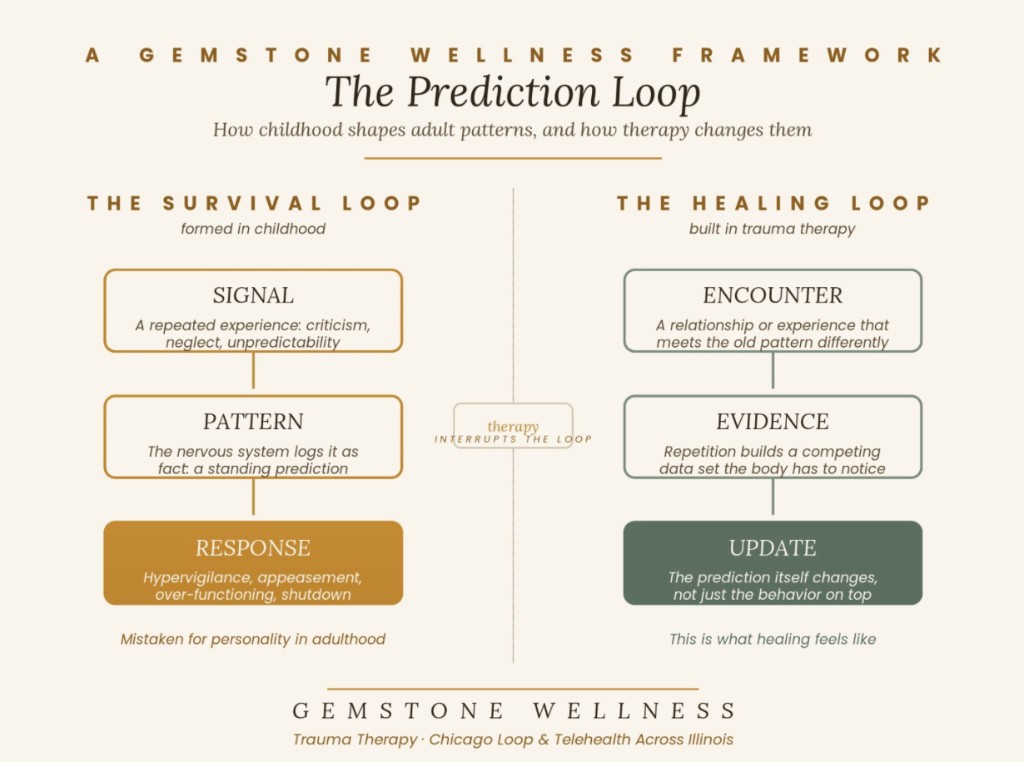
Here is a framework I use often in session, because it tends to make the abstract idea of “trauma response” concrete. I call it the Prediction Loop, and it works the same way whether it’s keeping you stuck or helping you heal.
In childhood, the loop runs like this: Signal → Pattern → Response. A repeated experience (criticism, unpredictability, neglect) becomes a signal your nervous system logs as fact. Enough repetition turns that signal into a standing pattern, a prediction about how people and situations like this one tend to go. And once the pattern is set, your nervous system stops waiting to see what actually happens. It generates the response in advance: hypervigilance, appeasement, over-functioning, shutdown, whatever kept you safest the first time. That response is often what gets mistaken for personality in adulthood, when it’s really a prediction running on autopilot.
Healing runs the same loop in a different direction: Encounter → Evidence → Update. A new kind of relationship or experience, one that meets your old pattern with something different than what it expects, becomes a new signal. Repeated encounters like that build evidence, a competing data set your nervous system has to start accounting for. Eventually, with enough evidence, the prediction itself updates, not just the behavior sitting on top of it. This is what change actually feels like from the inside: not a single breakthrough, but the slow outvoting of an old prediction by a new and more current one.
How Childhood Trauma Shows Up in Adult Life
Trauma rarely announces itself. Most adults don’t walk around thinking, “I’m reacting because of my childhood.” They think they’re anxious, or bad at relationships, or too sensitive, or not sensitive enough, or “just a perfectionist.” The nervous system doesn’t narrate its own history. It just keeps running the response it learned was necessary.
Difficulty relaxing is one of the more common patterns. Rest creates guilt instead of relief. A quiet weekend feels wrong, like something important is being forgotten. This usually isn’t laziness in reverse. It’s a nervous system that learned safety came from staying alert or useful, and if slowing down once meant becoming vulnerable, the body may keep treating rest as unsafe long after the original circumstances changed.
High achievement paired with chronic insecurity shows up just as often. Ambition on its own isn’t evidence of trauma; plenty of people are simply driven. The more useful question isn’t whether someone succeeds, but why success feels necessary. Excellence that grows from curiosity looks different than excellence that grows from a fear of disappointing people, or a belief that mistakes will cost you connection.
Confusing or exhausting relationships often trace back to what attachment researchers call internal working models, the templates for closeness that get built in the earliest relationships and then quietly run every relationship after. Foundational work by John Bowlby and Mary Ainsworth, and later research on adult attachment, showed that when early closeness was unpredictable, critical, or inconsistent, intimacy in adulthood tends to inherit that same uncertainty. You might crave connection while pulling away the moment someone gets close, assume anger before anyone’s said a word, over-explain yourself constantly, or become the caretaker in every relationship while feeling strange receiving care yourself.
Minimizing your own pain is a quieter sign, and it’s often more telling than distress itself. Someone describes something genuinely painful, then laughs, or adds, “it wasn’t that bad,” or “I’m sure they did their best.” They might be right. But understanding a parent’s limitations and understating your own pain aren’t the same thing, and plenty of adults have gotten so practiced at the second one that they no longer notice they’re doing it.
Not knowing what you need rounds out the list. Someone asks what you want, and the honest answer is you don’t know, not because you lack preferences, but because you spent years tracking everyone else’s needs instead of your own. This can look like people pleasing, trouble with boundaries, or exhaustion that never quite turns into asking for help.
To be clear: none of these patterns proves childhood trauma occurred. Perfectionism doesn’t automatically mean trauma. Neither does anxiety, or people pleasing. Human beings are complicated, and these patterns can develop for a lot of reasons. The point isn’t to diagnose yourself from a blog post. It’s to get curious about not just what you’re doing, but what your nervous system learned that made the response make sense.

Why So Many Adults Say, "Nothing Bad Happened to Me"
This is one of the most common things I hear, and sometimes it’s simply true. Other times, it reflects something else: a person who learned early on that their own experience wasn’t important enough to count. Those two things look identical from the outside and feel very different up close, which is why I try to meet the sentence with curiosity rather than certainty.
Many adults grew up believing that unless something dramatic happened, they don’t have the right to struggle, and that if someone else had it worse, gratitude is the only acceptable response. Gratitude has its place, but comparison can also become a way of dismissing your own experience before you’ve actually looked at it. People who are genuinely well connected to themselves tend to hold both joy and pain without needing to erase either one. When someone consistently waves off their own experience, it often means they learned somewhere along the way that their feelings mattered less than keeping the peace.
Healing Begins With Understanding, Not Blame
A concern I hear a lot is that naming childhood trauma means betraying a parent. It doesn’t. Understanding is different from blame. Many parents loved their children deeply while carrying real wounds of their own, and did the best they could with what they had. Both things can be true at once: your parents did their best, and your nervous system still adapted in ways that no longer serve you. Healing doesn’t start by deciding who was good or bad. It starts by understanding what happened inside you, because once you understand what your nervous system learned, you can start teaching it something new.
I’ve had clients tell me a previous therapist said something like, “You can treat childhood trauma, but you can’t heal it.” I understand the impulse behind that statement, trauma does leave lasting marks. But I don’t agree with the conclusion. The nervous system that learned to expect danger is the same nervous system that can learn to recognize safety, because it never fully stops learning throughout a person’s life. Healing isn’t pretending the past didn’t happen. It’s letting your present experience become stronger evidence than your past predictions.
Healing Happens in Relationship
Trauma this early often develops in relationship, which is part of why it can feel so persistent, and why it also tends to heal in relationship. Attachment researchers have documented something they call earned secure attachment: the finding that adults who didn’t have consistent safety in childhood can still build a secure, trusting attachment style later in life through corrective relational experience. Books and self-reflection genuinely help, but there’s something a self-help book can’t replicate about experiencing, in real time, a relationship where your thoughts and feelings are consistently met with curiosity instead of judgment.
That’s the foundation of how trauma therapy at Gemstone Wellness works. Techniques like somatic work and trauma-focused CBT matter, but the relationship between client and therapist is often what actually rebuilds trust in real time: proof that you can make a mistake and still be accepted, disagree and still be connected, need something and not become a burden. That evidence accumulates slowly, and it’s genuinely corrective. Over time, new evidence changes expectations.


Healing Doesn't Mean Becoming a Different Person
A worry I hear often is that healing will erase who someone is. If I stop striving so hard, will I lose my ambition? If I become less vigilant, will I stop succeeding? Healing isn’t about becoming someone else. It’s about gaining flexibility. The person who’s always been responsible doesn’t become irresponsible; they discover they can rest without guilt. The person who’s always cared for others doesn’t stop being compassionate; they learn their own needs count too. The goal isn’t to strip away the strengths trauma helped build. It’s to loosen the grip trauma has on them, so resilience, empathy, and determination become choices instead of survival strategies.
When to Consider Trauma Therapy in Chicago
You don’t need certainty that you experienced childhood trauma before reaching out for support. Most people start therapy because they’ve noticed a pattern they don’t want to keep carrying: anxiety that follows them even when life is stable, relationships that repeatedly leave them feeling misunderstood, or a sense that their reactions are bigger than the situations that trigger them. None of that automatically means childhood trauma is present. It does mean the pattern deserves real attention.
If anxiety is the loudest part of what you’re noticing, it’s worth reading more about anxiety therapy, since trauma and anxiety often travel together and respond to a lot of the same care. Trauma counseling in Chicago isn’t about convincing you that something traumatic happened. It’s about understanding how your experiences shaped who you became, so you can build a life that doesn’t have to keep revolving around survival. If what you’re carrying feels broader than any one label, general individual therapy is often the right place to start the conversation.
Final Thoughts
Childhood teaches all of us what to expect from relationships, from ourselves, from the world. Some of those lessons help us thrive. Others quietly keep us stuck long after they stopped protecting us. The good news is that the nervous system that learned through experience can also heal through experience, and watching that happen, watching someone slowly trade fear for trust, self-criticism for compassion, survival for something closer to actually living, is one of the real privileges of this work. Your childhood may explain a great deal of your story. It doesn’t get to determine how the rest of it is written.
If you’re looking for trauma therapy at Gemstone Wellness in Chicago and want a practice that treats the nervous system, not just the symptom list, Gemstone Wellness offers in-person sessions in the Loop and secure telehealth across Illinois. Schedule a free consultation whenever you’re ready to start understanding your own story.
Frequently Asked Questions About Childhood Trauma in Adults
What counts as childhood trauma?
Childhood trauma includes experiences that overwhelm a child’s ability to cope, or that repeatedly communicate that the world isn’t safe. Abuse, neglect, violence, and serious accidents are well-known examples, but trauma can just as easily develop through chronic emotional invalidation, unpredictable caregiving, persistent criticism, or growing up without consistent safety or support. Impact tends to depend less on whether an event looks dramatic from the outside, and more on what it taught a developing nervous system.
What are the signs of childhood trauma in adults?
Common patterns include anxiety, hypervigilance, perfectionism, difficulty trusting others, people pleasing, emotional numbness, and a tendency to minimize your own needs. Others show up as boundary struggles, chronic guilt, relationship difficulty, or feeling responsible for everyone around you. None of these patterns confirm childhood trauma on their own. They’re an invitation to get curious, not a diagnosis to hand yourself.
Can childhood trauma show up later in life, even if I didn't notice it before?
Yes. Many people don’t recognize the effects of childhood trauma until adulthood, often triggered by a major transition: becoming a parent, entering a serious relationship, a loss, or simply slowing down after years of constant achievement. It’s common to seek therapy years or decades after the original experiences happened.
Do I need to remember everything that happened to have been affected by it?
No. Memory during childhood is complex, and some people remember very little of what shaped them. Trauma therapy isn’t about recovering forgotten memories. It’s about understanding the patterns that exist right now and exploring how they likely developed.
Is childhood trauma the same thing as PTSD?
Not necessarily. Some people who experienced childhood trauma go on to develop PTSD. Others live with symptoms that don’t meet the full diagnostic criteria but still affect relationships, self-esteem, and daily functioning. Many adults who experienced ongoing childhood adversity identify more with what’s often called complex trauma than with a single traumatic event.
Can childhood trauma actually be healed?
Yes. Healing doesn’t mean forgetting the past or pretending it didn’t happen. It means your nervous system is no longer organized around surviving something that’s already over. Through supportive relationships, trauma-informed therapy, and repeated experiences of safety, most people find they can respond to life with more flexibility and self-compassion than they thought possible.
How do I know if I should look into trauma therapy?
You don’t need a diagnosis or certainty that trauma occurred before starting. If you keep running into anxiety, perfectionism, relationship strain, or a disconnect from yourself, talking with a trauma-informed therapist can help clarify what’s actually driving it. The goal isn’t to convince you something happened. It’s to help you understand your own story well enough to change how it continues.
Can childhood trauma affect physical health?
Yes. The CDC-Kaiser ACE Study found a graded, dose-response relationship between adverse childhood experiences and many of the leading causes of death in adults, along with elevated rates of chronic disease, sleep disruption, and stress-related symptoms. Physical symptoms have many possible causes, so ongoing health concerns should always be discussed with a medical provider, but the link between early stress and long-term physical health is well documented.