
By Jenny Martin, PsyD
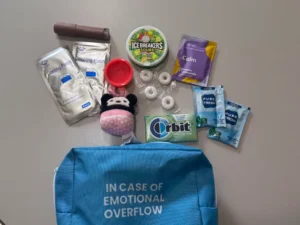
If you’ve scrolled TikTok lately, you’ve probably seen it. Someone unzips their bag and shows off their “anxiety kit,” a little collection of stress balls, gum, essential oils, and fidget toys they carry everywhere. It’s called an anxiety bag, and Gen Z has turned it into a whole genre of content.
I was recently quoted in the New York Post about this exact trend. When their reporter reached out asking why anxiety bags were suddenly everywhere, I had a lot to say. There’s real psychology behind it, and it goes well beyond the cute aesthetic. I actually love making these in session with clients and have one of my own. (Shout out to the Shakti ball and Nice Cube).
What to Put in an Anxiety Bag
If you’re wondering what to put in an anxiety bag (sometimes adorably called panic pouches), most of them follow a similar formula. You’ll find something to fidget with, something to smell, something to chew, something to read or listen to. The goal is simple: give your nervous system a menu of quick, physical ways to come back down when anxiety spikes.
It’s not that different from what we call a grounding technique. Gen Z just gave it better branding.
Why This Trend Actually Makes Sense
Anxiety isn’t only a thought problem. It’s a body problem too.
When your nervous system floods with stress, your brain isn’t exactly in the mood to reason its way out. That’s where the sensory stuff earns its keep. A cold sip of water, a strong smell, a textured object in your hand, any of these can interrupt the spiral and pull your body back into the present moment.
This is basically what happens in anxiety therapy, just without the cute packaging. Grounding techniques for anxiety are some of the first tools I teach clients, because they work fast and don’t ask you to think your way out of anxiety when your brain is already overloaded.
Where Anxiety Bags Fall Short
Here’s the thing though. An anxiety bag can get you through a rough five minutes. It won’t tell you why you’re anxious in the first place.
If you’re reaching for your kit every single day, multiple times a day, that’s worth paying attention to. It might mean your anxiety needs more than a fidget toy can offer.
That’s usually the point where people start looking into actual anxiety therapy, not because grounding tools don’t work, but because they’re ready to understand what’s driving the anxiety underneath.
What Real Anxiety Treatment Looks Like
In my practice, anxiety therapy usually blends a few approaches. We use CBT to help you notice and challenge the thought patterns keeping anxiety on a loop. We also lean on mindfulness and nervous system regulation work, similar in spirit to what’s happening with those anxiety bags, just with a lot more structure behind it.
The goal isn’t to erase anxiety completely. Some anxiety is normal, even useful. The real goal is making sure it’s not running your whole day.
Grounding Techniques for Anxiety You Can Try Right Now
You don’t need a full anxiety bag to borrow from the trend. Here are a few simple tools that work in a pinch.
Try the 5-4-3-2-1 technique. Name five things you can see, four you can touch, three you can hear, two you can smell, and one you can taste. It sounds almost too simple, but it pulls your brain out of spiral mode and back into your actual surroundings.
Keep a piece of hard candy or gum nearby. The act of chewing genuinely helps regulate your nervous system.
Carry something with a strong, pleasant scent, like a small rollerball of essential oil. Smell is wired directly into the emotional centers of your brain, which is part of why it works so fast.
Try slow, deep breathing, in for four counts, hold for four, out for six. Slowing your exhale signals to your nervous system that the danger has passed.
Take a short walk when anxiety spikes, even just around the block. Movement burns off some of that excess stress energy your body’s been holding onto.
Signs You Might Need Anxiety Therapy
A coping kit is great for the moment you’re in. It’s not designed to answer the bigger question: why does this keep happening?
A few signs it might be time for anxiety therapy: you’re using your grounding tools daily, anxiety is interrupting your sleep, or it’s making it hard to enjoy things you used to love. None of that means something is wrong with you. It just means your nervous system could use more support than a fidget toy can offer.
At Gemstone Wellness, I offer anxiety therapy in Chicago’s Loop, in person and virtually, with bilingual and LGBTQ+ affirming care. If the anxiety bag trend has you thinking about your own anxiety a little differently, that’s a good sign you’re ready to dig a little deeper.
Quick Questions About Anxiety Bags and Grounding
What should I put in an anxiety bag?
A good anxiety bag usually has something to touch (a fidget toy or textured object), something to smell (essential oil or scented lotion), something to chew (gum or hard candy), and something to distract your mind, like a puzzle or a playlist.
What is the 5-4-3-2-1 grounding technique?
It’s a grounding exercise that walks your brain through your senses: five things you see, four you touch, three you hear, two you smell, and one you taste. It’s one of the fastest ways to interrupt an anxiety spiral.
Do anxiety bags actually work?
Yes, for the moment you’re in. They give your nervous system something concrete to focus on, which can genuinely calm you down. They’re not a replacement for treatment if anxiety is a daily struggle.
How do I know if I need anxiety therapy?
If anxiety shows up most days, disrupts your sleep, or keeps you from things you used to enjoy, that’s usually a sign it’s time for more support than grounding tools alone can offer.